Hand behind back (HBB)
 What movement is it?
Yes! Literally, you are putting your hand behind your back. This is a common repetitive task for a female, right? It means that you may often come across patients with shoulder pain, especially unable to put their hand behind their back.
How do you assess and treat them?
I know it is tricky. Simple massaging can help enhance its mobility and reduce pain.
However, what if not? It can be more complicated than that? Sorry. Let me say it again! It can be simple to improve but easy to neglect what may be contributing to that problem.
What can be a problem for this dysfunctional movement?
- When I was at uni, I learned that tight shoulder external rotators can restrict HBB. It sounds plausible. Then, its treatment can be releasing them. However, some patients do not respond to it well.
Why is it?
Yes! It is very simple. The tightness of shoulder external rotators is not the main problem.
Let’s break down this movement.
1st you are internally rotating and extending your shoulder until reaching the sacrum, right?
- Yes! It sounds reasonable that if your shoulder external rotators are tight, this shoulder internal rotation can be limited. However, you may often see them able to reach their lower back but unable to elevate their hand towards the mid back, right?
What does it mean? Yes! You do not need a lot of shoulder internal rotation to be able to complete HBB. According to research, you only need shoulder internal rotation to reach the sacrum.
 2nd where do you go after reaching the sacrum?
Yes! elbow flexion. That's it!
However, most patients during HBB complain about anterior or lateral shoulder pain.
What does it mean? Still tight shoulder external rotators? Or poor glenohumeral joint stabilisation?
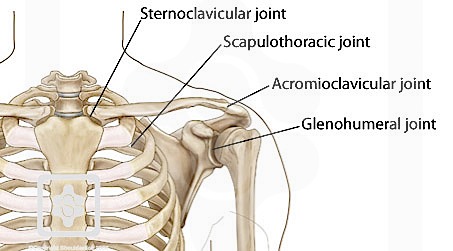
In the literature, HBB requires a good control of scapulothoracic joint that can be supported by mid/lower trap/serratus anterior and others. Of course, you need to think about the importance of rotator cuff muscles. What do they do? Yes! They place the glenohumeral joint into the glenoid fossa during shoulder movement.
On top of that, do not forget the thoracic rotation.
Why?
Restricted Tx rotation can contribute to the function of scapulothoracic joint, right? Think of someone with hyperkyphotic upper back in the office. When you see someone like this, please assess their Tx rotation and extension.
To be able to have full shoulder flexion, you need a good thoracic extension during last 10 degs of shoulder flexion. For instance, when you lift your arm up, you don’t have shoulder pain but cannot pass your ear. Why is that? Is it because of tight shoulder muscles or a lack of thoracic extension? Tx mobility plays an important role in shoulder movement. You can actually experiment on yourself in front of a mirror. Lift your arm up in a stoop position and in a straight sitting position. You can see and feel the difference.
The bottom line is that do not just look at where pain is but connect dots!
To complete HBB, the stable scapulothoracic joint is more required than shoulder internal rotation.
Lets get it!
Comments
Post a Comment